Hard water is one of those household problems that quietly damages appliances, clogs pipes, and leaves residue on everything from shower doors to coffee makers. If you’re noticing soap scum, spotty dishes, or a stiff feeling to your laundry, your home’s water likely contains high levels of minerals like calcium and magnesium. A Nuvo water softener offers a practical solution without the mess and maintenance of traditional salt-based systems. This guide walks you through what Nuvo systems are, how they stack up against other options, and whether one fits your home’s needs, so you can make a confident decision about tackling hard water once and for all.
Table of Contents
ToggleKey Takeaways
- Nuvo water softeners use salt-free crystallization technology to transform hard water minerals into harmless crystals without requiring ongoing salt purchases or drain lines, making them a low-maintenance alternative to traditional systems.
- Hard water reduces water heater efficiency by 15–20% and shortens appliance lifespan; a Nuvo system eliminates scale buildup and protects your home’s plumbing and equipment from mineral damage.
- Nuvo cartridges need replacement every 6–12 months and take only five minutes to swap, making maintenance far simpler than salt-based systems that require regular salt refilling and regeneration cycles.
- DIY installation is feasible for homes with compression fittings on the main water line and typically takes 30 minutes, but professional installation ($300–$600) is recommended for soldered copper, PEX tubing, or complex plumbing situations.
- Choose your Nuvo model based on household water usage and hardness level: the H2O fits smaller homes, the H2O-Max handles larger families, and the H2O-Manor tackles the toughest hard water conditions up to 25 GPM.
What Is a Nuvo Water Softener and Why Your Home Needs One
A Nuvo water softener is a point-of-entry system that treats hard water at the main water supply line before it reaches your taps, appliances, and showers. Unlike traditional ion-exchange softeners that swap calcium and magnesium ions for sodium (salt), Nuvo systems use salt-free templated crystallization technology. This method transforms minerals into harmless crystals that flow through your pipes without sticking to surfaces or reducing water pressure.
Hard water is defined by the amount of dissolved minerals, measured in parts per million (ppm) or grains per gallon (GPG). Water above 3.5 GPG is considered hard and causes visible problems: reduced appliance lifespan, higher energy bills, dry skin and hair, and scaling inside water heaters and dishwashers. Studies show that hard water can reduce the efficiency of water heaters by 15–20% and shorten their lifespan by several years.
Why choose Nuvo specifically? Nuvo systems eliminate the need to buy, store, and add salt regularly, a task that’s inconvenient and costs money year after year. They also don’t require a drain line for backflushing, making installation simpler in homes without nearby floor drains. Because the water doesn’t go through a softening resin tank, you maintain full water pressure throughout your home, which matters if you have a large family or simultaneous water use.
Key Features and Benefits of Nuvo Water Softening Systems
Nuvo water softeners deliver several practical advantages over traditional salt-based units. First, they’re maintenance-free in the everyday sense, you never monitor salt levels, refill brine tanks, or schedule regeneration cycles that temporarily reduce water flow. The system works passively 24/7 without moving parts that wear out inside the tank.
Second, experts agree that top-rated water softeners for 2025 now include salt-free models as a serious alternative to traditional units, especially for homes concerned about sodium consumption. If anyone in your household follows a low-sodium diet or has a septic system sensitive to excess salt discharge, a salt-free approach solves both problems.
Third, Nuvo systems reduce scale buildup in pipes and appliances without removing the minerals that make water taste better or provide beneficial minerals for cooking. The crystallized minerals simply pass through without adhering to surfaces, a key advantage in homes with aging plumbing or water heaters nearing end-of-life.
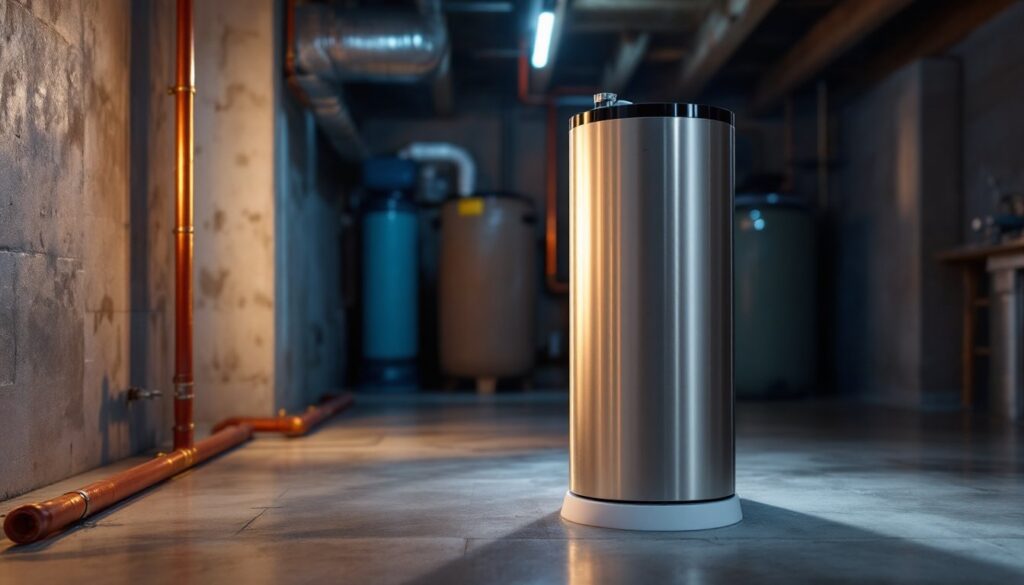
Nuvo models are also compact and fit in tight spaces like utility closets or basement corners. Most systems measure around 14 inches in diameter and less than 5 feet tall, compared to 18-inch-wide salt-based tanks. They’re quieter too, no regeneration cycle noise or valve clicks throughout the day.
Salt-Free Technology and How It Works
Nuvo’s core technology is template-assisted crystallization (TAC). Water passes through a special media made of polystyrene polymer beads embedded with nucleation sites. When hard water minerals encounter these sites, they crystallize and become suspended particles that flow harmlessly downstream rather than bonding to pipes or heating elements.
This process is different from softening (which removes hardness) and is technically called conditioning (which changes the mineral’s form). The result: mineral content stays the same, your water isn’t “softened” in the traditional sense, but hardness no longer causes scale, soap scum, or equipment damage.
The media cartridge inside lasts 6 to 12 months depending on water hardness and household usage. When it’s time to replace it, you twist out the old cartridge and insert a new one, a five-minute job requiring no tools or special knowledge. Unlike salt-based systems that need annual service calls or DIY filter changes, Nuvo cartridge replacement is straightforward.
Installation and Setup Considerations for DIY Homeowners
Installing a Nuvo water softener at the main water line is a manageable DIY project for homeowners comfortable with basic plumbing, but it requires shutting off your home’s water supply and making pipe connections. Most Nuvo units connect inline between your main water shutoff valve and the first branch of your home’s plumbing.
You’ll need:
• Adjustable wrenches (for tightening compression fittings)
• Teflon tape (for sealing threaded connections)
• Pipe cutter or hacksaw (if your main line is rigid copper or PVC)
• Bucket (to catch residual water)
• Level (to ensure the unit hangs or sits straight)
• Thread seal tape or plumber’s putty (depending on your connection type)
Before starting, locate your main water shutoff and test that it closes fully. Turn off water at the meter if you can’t shut it off at the house valve. Open a lower-floor faucet to release residual pressure, then have a bucket ready.
Measure your main water line’s diameter, typically 3/4 inch or 1 inch. Nuvo systems come in configurations for both sizes. If your main line is 1 inch but your connections are 3/4 inch, you’ll need reducers: check your Nuvo kit first.
When to Call a Professional vs. DIY Installation
Hire a licensed plumber if:
• Your main water line is soldered copper or PEX tubing and you’ve never worked with these materials. Soldering requires a torch and skill: PEX requires special crimpers.
• Your main water shutoff is inaccessible, stuck, or non-functional. A plumber can install a new shutoff valve before the Nuvo system.
• Building codes in your area require a licensed plumber for main-line water treatment installations. Check with your local building department, some jurisdictions require permits and licensed work.
• You’re uncomfortable shutting off your main water and tolerating temporary service interruption during installation.
A professional installation costs $300 to $600 on average (labor only: the unit itself is separate). It’s insurance against leaks and ensures the system meets code. If your home’s plumbing is fragile, older, or you’ve never tackled main-line work, that cost is worth peace of mind.
DIY installation works well if your main line uses compression fittings (most common in modern homes with rigid copper or PVC lines). These require only wrenches and Teflon tape, making it a 30-minute job.
Maintenance and Long-Term Care Tips
Nuvo water softeners are genuinely low-maintenance, but a few practices extend their life and keep them working efficiently.
Cartridge Replacement is the main task. Most cartridges cost $60 to $100 and last 6 to 12 months depending on hardness level and household water usage. Set a calendar reminder for the replacement window suggested in your manual. Replacing it early is harmless: waiting too long reduces conditioning effectiveness.
When you replace the cartridge, flush the system. Turn water back on and let it run at a sink for 30 seconds to purge air and particles. You may notice slightly discolored water for a minute, that’s normal.
Check inlet and outlet ports annually for leaks or corrosion. Compression fittings can loosen slightly over time: if you spot a drip, gently tighten the fitting with two wrenches (one holding the nut, one turning the fitting body). Don’t over-tighten or you’ll crack the fitting.
Monitor water pressure at a tap near the system. Normal pressure is 40–80 psi. If it drops below 40 psi and the cartridge isn’t overdue, the media inside may be clogged, a rare issue. Contact Nuvo customer support: you may need a cartridge replacement or system service.
If you have sediment in your water (visible particles, discoloration, or a rotten-egg smell from hydrogen sulfide), install a pre-filter before your Nuvo unit. A 10-micron sediment cartridge ($20–30) stops debris from clogging the Nuvo media. Replace the pre-filter every 3–6 months depending on sediment load.
For households with very high hardness (above 15 GPG), Nuvo recommends professional water testing annually. Some retailers offer free or low-cost hardness tests: others charge $50–100 for a comprehensive analysis. This confirms the system is performing as expected.
How to Compare Nuvo Models: Finding Your Best Fit
Nuvo offers several models tailored to different household sizes and water hardness levels. The key comparison factors are system capacity (measured in GPD, or gallons per day) and connection size (3/4 inch or 1 inch).
Nuvo Home H2O is the entry-level model, designed for smaller homes or apartments with low-to-moderate hardness. It handles up to 25 GPG and is compact, ideal for tight spaces.
Nuvo Home H2O-Max steps up for larger households or harder water. It’s rated for hardness up to 75 GPG and flows up to 20 GPM (gallons per minute), which matters if you have a large family using water simultaneously.
Nuvo Home H2O-Manor is the premium option, handling the toughest conditions, up to 25 GPM flow and effective on very hard water. Professional reviewers and comprehensive water softener comparisons often highlight this model for its reliability and performance in challenging water environments.
To choose, calculate your household’s daily water usage (average is 60–80 gallons per person per day) and measure your water hardness. Most local water utilities provide free hardness reports: if yours doesn’t, buy a test kit ($15–25) at a hardware store. Multiply daily usage by hardness level to find your ideal GPD capacity.
Example: A family of four uses 320 gallons daily in water with 12 GPG hardness. You’d want a system handling at least 3,840 GPD, the H2O-Max fits this scenario.
Also confirm your main water line diameter (3/4 or 1 inch) before ordering. Undersizing the connection reduces pressure: oversizing wastes the system’s footprint. Nuvo’s sizing guide on their website walks through this, or call their customer service for a recommendation.